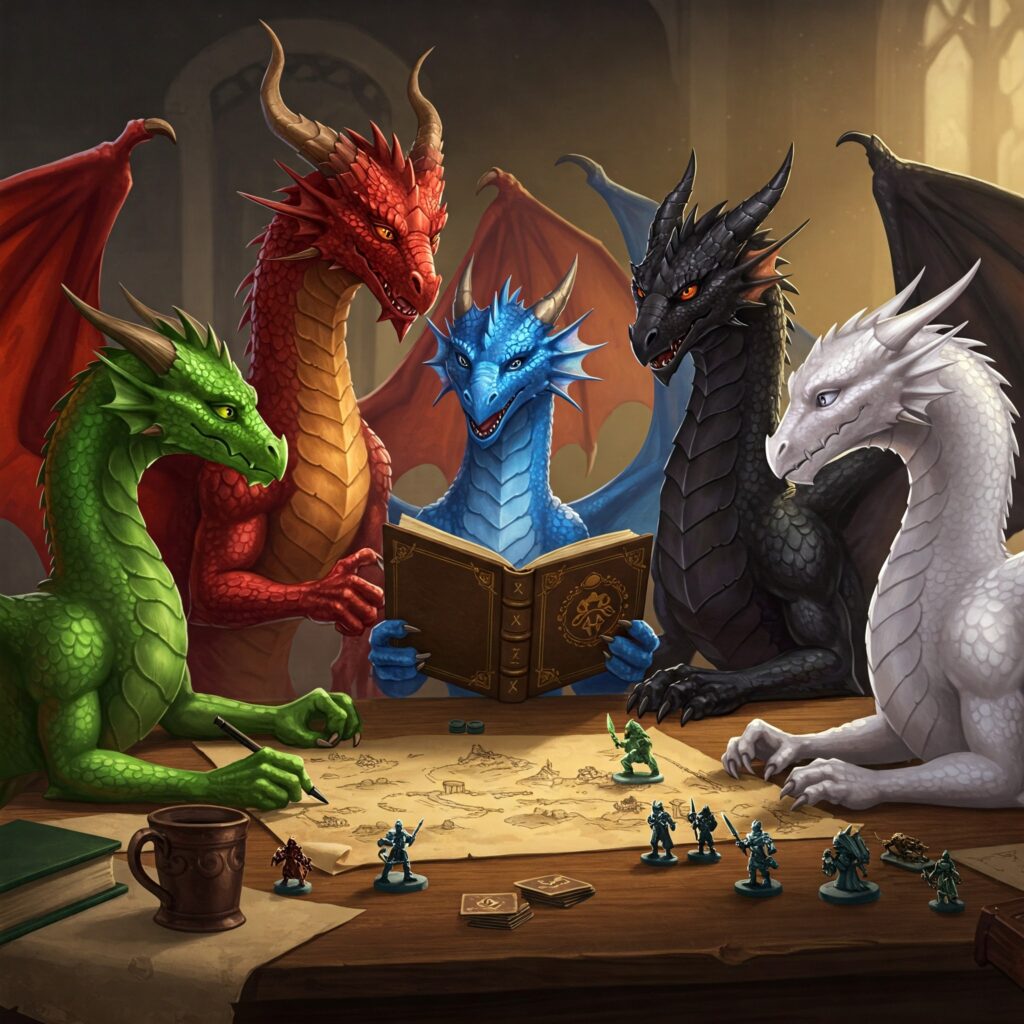
Ever dreamt of wielding mighty spells, battling fierce dragons, or uncovering ancient secrets? Welcome to the world of tabletop role-playing, where your imagination brings incredible stories to life! This guide will walk you through the basics of gameplay, using a System Reference Document (SRD) as our foundation – a core set of rules that powers many fantasy adventures.
The Heart of the Game: Your Character & The Dice
It all starts with your character. You’ll create a unique hero with their own strengths and weaknesses, defined by six main ability scores: Strength, Dexterity, Constitution, Intelligence, Wisdom, and Charisma. Each score has a modifier that you’ll add to dice rolls.
When your character tries to do something where the outcome is uncertain – like scaling a treacherous cliff, convincing a stubborn guard, or dodging a magical blast – you’ll make a D20 Test. This means you’ll roll a 20-sided die (d20).
- Ability Checks: For tasks and skills.
- Attack Rolls: To see if you hit an enemy in combat.
- Saving Throws: To resist spells, traps, or other harmful effects.
Sometimes you’ll have Advantage (roll two d20s, use the higher) or Disadvantage (roll two d20s, use the lower). As you get better, you’ll add your Proficiency Bonus to rolls you’re skilled in. The number you need to meet or beat is the Difficulty Class (DC).
Your character also has:
- Hit Points (HP): A measure of their health.
- Armor Class (AC): How hard they are to hit.
- Alignment: A general sense of their ethics (e.g., Lawful Good, Neutral Evil).
Taking Action: What Can You Do?
When it’s your turn, you can do several things:
- Take an Action: This is your main activity. Common actions include:
- Attack: Strike with a weapon or an Unarmed Strike.
- Magic: Cast a spell.
- Dash: Move extra distance.
- Disengage: Move away from an enemy safely.
- Dodge: Focus on avoiding attacks.
- Help: Assist an ally.
- Hide: Attempt to become unseen.
- Search: Look for something hidden.
- Utilize: Interact with certain objects.
- Take a Bonus Action: A quicker, secondary action if a spell or feature allows it.
- Take a Reaction: Respond to a trigger, even on someone else’s turn.
Into the Fray: The Thrill of Combat
Combat is a dynamic part of the adventure!
- Initiative: At the start of a battle, everyone rolls for initiative to determine the turn order.
- Attack vs. AC: You’ll make an attack roll with your d20, add modifiers, and try to meet or exceed the target’s Armor Class (AC).
- Critical Hits: Rolling a natural 20 on an attack roll is a critical hit, often dealing extra damage!
- Damage: Successful attacks reduce a target’s HP.
- Conditions: Characters and creatures can be affected by various conditions like Blinded, Charmed, Frightened, Grappled, Incapacitated, Paralyzed, Poisoned, Prone, Restrained, Stunned, or Unconscious, each imposing specific limitations.
The Weave of Magic: Casting Spells
Magic is a powerful force, allowing characters to perform incredible feats.
- Spells & Levels: Spells range from simple Cantrips (level 0 spells you can cast anytime) to mighty 9th-level spells.
- Spell Slots: To cast spells of 1st level or higher, you expend a spell slot of the appropriate level.
- Components: Spells often have Verbal (V), Somatic (S), or Material (M) components that must be provided.
- Casting Time: Most spells are cast as an Action, but some are Bonus Actions or Reactions. Some can also be cast as Rituals, taking longer but not using a spell slot.
- Concentration: Some ongoing spells require you to maintain concentration; if it’s broken (often by taking damage), the spell ends.
Equipping for Danger: Gear and Treasures
No adventurer is complete without their gear!
- Armor and Weapons: Essential for survival and combat.
- Magic Items: The world is full of wondrous magic items, from common potions that heal to powerful artifacts. Many require you to attune to them to unlock their full power. You might find magical scrolls allowing you to cast a spell one time.
The Adventuring Life: Exploration and Rest
Adventures will take you to amazing and dangerous places.
- Travel & Movement: Your character’s speed determines how far they can move. Sometimes you’ll encounter Difficult Terrain that slows you down.
- Lifestyle: Your character has lifestyle expenses, reflecting their standard of living.
- Rest: To recover from their exploits, characters need rest:
- Short Rests (about an hour) allow spending Hit Dice to regain HP.
- Long Rests (8+ hours) restore all HP, Hit Dice, and many abilities.
The World Awaits: Monsters & Challenges
Your Game Master (GM) will populate the world with fascinating characters, intriguing plots, and, of course, monsters! The SRD contains a host of creatures, each with a stat block detailing their abilities, AC, HP, attacks, and Challenge Rating (CR) – a measure of their toughness.
This is just a glimpse into the rich tapestry of gameplay. The System Reference Document provides the framework, but the stories you create are limitless. So gather your friends, roll some dice, and let the adventures begin!