Welcome, aspiring adventurer, to the thrilling world of Advanced Dungeons & Dragons 5th Edition! This guide is crafted specifically for you, the player, to help you navigate the exciting and sometimes perilous journey of a Player Character (PC). We’ll explore the fundamental rules and concepts of AD&D 5E from your perspective, empowering you to create a memorable hero and dive headfirst into epic tales.
Get ready to forge your destiny, explore ancient ruins, battle fearsome monsters, and shape the very fabric of the world alongside your companions. Let’s begin!
Chapter 1: Forging Your Legend: Character Creation
Your journey begins with creating your character, the hero you will embody throughout your adventures. This process involves several key choices that define who your character is and what they can do.
Your Species (Race)
Your species is more than just your appearance; it grants you unique traits, abilities, and often a cultural background. The System Reference Document (SRD) outlines various species, each with their own strengths and characteristics. For instance, as a Humanoid, you’ll find yourself among the most common and adaptable beings in the world. Consider what appeals to you – perhaps the resilience of a Dwarf, the agility of an Elf, or the versatility of a Human.
Your Calling (Class)
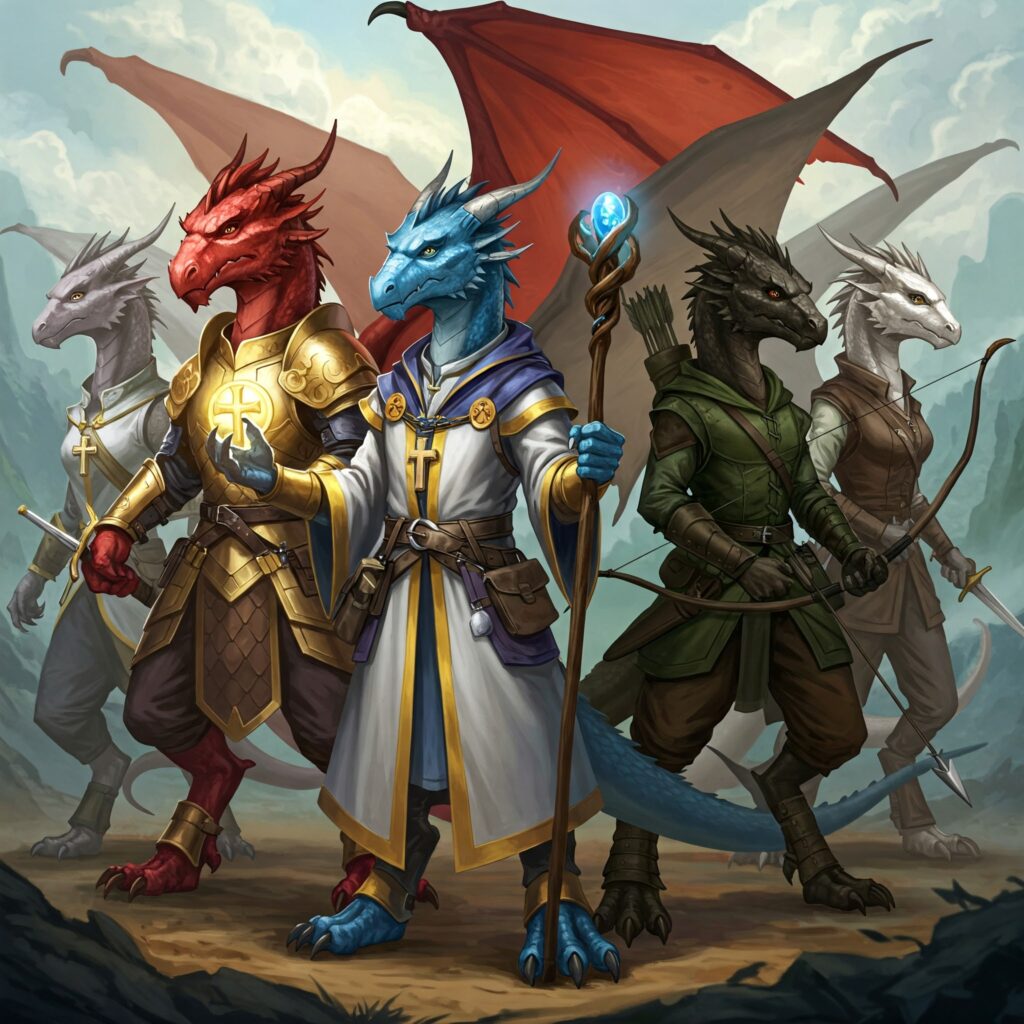
Your class defines your character’s primary role and abilities. Are you a valiant Fighter, a cunning Rogue, a wise Cleric, or a powerful Wizard? Each class grants you specific proficiencies, features, and a distinct playstyle. As you gain experience, your class will unlock new powers and deepen your capabilities.
Your Core Strengths: Ability Scores
Every creature, including your character, has six core Ability Scores:
- Strength (Str): Measures physical power, athletic prowess, and carrying capacity.
- Dexterity (Dex): Reflects agility, reflexes, and balance.
- Constitution (Con): Represents endurance, stamina, and health.
- Intelligence (Int): Determines reasoning, memory, and analytical ability.
- Wisdom (Wis): Governs perception, intuition, and common sense.
- Charisma (Cha): Dictates force of personality, persuasiveness, and leadership.
Each score has a corresponding modifier (e.g., a Strength of 15 gives a +2 modifier). This modifier is added to your d20 rolls when you perform actions related to that ability.
What You Know: Skills and Proficiencies
Skills are specialized areas of your abilities (e.g., Athletics is a Strength skill, Stealth is a Dexterity skill). If you have proficiency in a skill, you add your Proficiency Bonus (PB) to any d20 test you make using that skill. Your PB increases as your character gains levels, reflecting your growing expertise.
You can also have proficiency with certain weapons or tools, allowing you to use them effectively. Without the proper armor training, wearing certain armor can impose Disadvantage on Strength and Dexterity D20 Tests and prevent you from casting spells.
Your Past: Background
Your background represents what your character did before becoming an adventurer. It provides flavor, suggests personality traits, and grants you a few starting proficiencies and equipment. It’s a great way to tie your character into the world and give them a personal history.
Your Gear: Equipment
Every adventurer needs tools for their trade. You’ll start with equipment based on your class and background, including:
- Weapons: Used for attacking. They come in various types (melee, ranged) and categories (simple, martial).
- Armor: Provides an Armor Class (AC) bonus, making you harder to hit.
- Adventuring Gear: Essential items like backpacks, ropes, torches, and rations.
Staying Alive: Hit Points and Hit Dice
Hit Points (HP) represent your character’s health and resilience. When you take damage, your HP decreases. When you receive healing, your HP increases. If your HP drops to 0, you’re in trouble!
Hit Dice (HD) are a pool of dice you can spend during a Short Rest to regain HP. Each class has a specific type of Hit Die (e.g., Fighters use d10s, Rogues use d8s).
Your Moral Compass: Alignment
Your alignment broadly describes your character’s ethical attitudes and ideals. It’s a combination of morality (Good, Evil, or Neutral) and attitudes toward order (Lawful, Chaotic, or Neutral). While it doesn’t impose strict rules, it can guide your roleplaying and influence how others perceive your character.
Beyond the Basics: Feats
Feats are optional rules that allow you to customize your character further by granting them special abilities or improving existing ones. They represent unique talents, training, or experiences your character has gained.
- When You Gain Feats: Typically, when your character reaches certain levels in their class, they have a choice: either increase one or two of their Ability Scores, or gain a Feat. Your GM will let you know if feats are in play for your campaign.
- What Feats Do: Feats can provide a wide range of benefits, such as:
- Improving your combat prowess (e.g., granting new attack options or making you more resilient).
- Granting proficiency in new skills or tools.
- Providing special actions or reactions you can take.
- Enhancing your spellcasting.
- Giving you unique ways to interact with the world or other creatures.
- Choosing a Feat: Each feat has specific prerequisites you must meet to take it. When you gain a feat, choose one that aligns with your character’s concept and playstyle.
Chapter 2: The Flow of Adventure: Core Gameplay Mechanics
AD&D 5E uses a simple, consistent system for resolving actions: the d20 Test.
The Universal Roll: D20 Tests
Whenever you try to do something with an uncertain outcome, your Game Master (GM) will ask you to make a d20 Test. This involves rolling a 20-sided die (d20) and adding relevant modifiers. There are three main types of d20 Tests:
- Ability Checks: Used when you attempt to perform an action using one of your six abilities (e.g., a Strength (Athletics) check to climb a wall).
- Attack Rolls: Used when you try to hit a target with a weapon, an Unarmed Strike, or a spell. See the “Striking Your Foes: Attack Rolls” section below for more details.
- Saving Throws: Used to avoid or resist a harmful effect. See the “Resisting Threats: Saving Throws” section below for more details.
Striking Your Foes: Attack Rolls
When you attempt to hit a creature or object with a weapon, an Unarmed Strike, or a spell, you make an attack roll. This is a crucial part of combat, determining whether your efforts land true.
When to Make an Attack Roll:
You make an attack roll whenever you use an action like “Attack” in combat, or when a spell or special ability requires you to make one.
How to Make the Roll:
To make an attack roll, follow these steps:
- Roll a d20: This is the core of your attack.
- Add your Ability Modifier:
- Melee Weapon Attacks: Add your Strength modifier.
- Ranged Weapon Attacks: Add your Dexterity modifier.
- Finesse Weapons: For weapons with the Finesse property (like a rapier or shortsword), you can choose to use either your Strength or Dexterity modifier.
- Unarmed Strikes: Add your Strength modifier.
- Spell Attacks: Add your spellcasting ability modifier (e.g., Intelligence for Wizards, Wisdom for Clerics, Charisma for Sorcerers). Your character sheet will specify your spell attack modifier.
- Add your Proficiency Bonus (PB): If you are proficient with the weapon you are using (or if it’s an Unarmed Strike or a spell attack from a class you’re proficient in), you add your PB to the roll.
- Apply other modifiers: Some spells, magic items, or special abilities might grant you a bonus or penalty to your attack rolls.
- Compare to Armor Class (AC): Your total roll must be equal to or greater than the target’s Armor Class (AC) to hit.
Example Calculation (Melee Weapon Attack):
Let’s say your character has:
- Strength: 16 (Modifier: +3)
- Proficiency Bonus (PB): +2 (at level 1)
- You are proficient with Longswords.
When you attack with a Longsword:
Roll 1d20 + 3 (Strength modifier) + 2 (Proficiency Bonus) = 1d20 + 5
If your total roll is 15 and the enemy’s AC is 14, you hit!
Critical Hits:
If you roll a natural 20 on the d20 for an attack roll (before adding any modifiers), it’s a Critical Hit!
- A Critical Hit always hits, regardless of the target’s AC.
- You roll all of the attack’s damage dice twice and add them together, then add any relevant modifiers (like your ability modifier). This means your attack deals significantly more damage!
Misses:
If your total attack roll is less than the target’s AC, you miss. Your attack has no effect, unless a specific rule states otherwise (e.g., some spells have effects on a miss).
Spell Attack Modifier:
For spells that require an attack roll, your spell attack modifier is generally calculated as:
your spellcasting ability modifier+your Proficiency Bonus
Resisting Threats: Saving Throws
Saving throws are your character’s last line of defense against dangerous effects, from a dragon’s fiery breath to a wizard’s mind-altering spell. When an effect calls for a saving throw, you’ll roll a d20 to see if you can resist or mitigate the threat.
When to Make a Saving Throw:
The GM will tell you when to make a saving throw. This usually happens when:
- You are targeted by a spell that specifies a saving throw (e.g., “The target must make a Dexterity saving throw…”).
- You are subjected to a monster’s special ability that requires a save (e.g., a basilisk’s Petrifying Gaze).
- You encounter an environmental hazard or trap that calls for a save (e.g., dodging a collapsing roof).
How to Make the Roll:
To make a saving throw, you roll a d20 and add the modifier of the ability score specified by the effect (Strength, Dexterity, Constitution, Intelligence, Wisdom, or Charisma).
- Proficiency: Your class grants you proficiency in certain saving throws. If you are proficient in the required ability’s saving throw, you also add your Proficiency Bonus (PB) to the roll.
- Calculating the DC: The effect that triggers the saving throw will specify a Difficulty Class (DC). Your goal is to roll equal to or higher than this DC. If you’re resisting a spell cast by an enemy, the spell’s description or the GM will tell you the DC. If you’re casting a spell that requires a saving throw, your spell save DC is calculated as:8+your spellcasting ability modifier+your Proficiency Bonus
Effects of Success or Failure:
- Success: If your roll meets or exceeds the DC, you successfully resist or reduce the effect. The spell or ability description will detail what happens on a successful save (e.g., “On a successful save, the target takes half as much damage only”).
- Failure: If your roll is lower than the DC, you suffer the full effect of the spell or ability.
Voluntarily Failing a Save:
You can choose to fail a saving throw voluntarily without rolling. This can be useful if you want to be affected by a beneficial spell (e.g., a healing spell that targets creatures who fail a save) or if you believe failing is strategically advantageous.
Impact of Conditions and Abilities on Saves:
- Advantage/Disadvantage: Just like other d20 Tests, saving throws can be affected by Advantage (roll two d20s, take higher) or Disadvantage (roll two d20s, take lower).
- Automatic Failure: Certain conditions can cause you to automatically fail specific saving throws. For example, being Paralyzed or Petrified causes you to automatically fail Strength and Dexterity saving throws.
Gaining an Edge: Advantage and Disadvantage
Sometimes, circumstances give you an edge or hinder your efforts:
- Advantage: Roll two d20s and use the higher result.
- Disadvantage: Roll two d20s and use the lower result.If you have both Advantage and Disadvantage on the same roll, they cancel each other out, and you roll a single d20.
Your Growing Prowess: Proficiency Bonus
Your Proficiency Bonus (PB) is a number determined by your character’s level. You add your PB to any d20 Test for which you have proficiency (e.g., skills you’re trained in, weapons you’re proficient with, or saving throws your class grants).
Exploring the World
Exploration is a key pillar of AD&D.
- Movement: Your Speed dictates how far you can move on your turn. Different terrains can affect your movement: Difficult Terrain costs extra movement.
- Senses: Beyond normal sight, you might have Darkvision (seeing in dim light as bright light, and in darkness as dim light in shades of gray) or even Blindsight or Truesight.
- Travel Pace: When traveling long distances, your group will choose a pace (Normal, Fast, or Slow), affecting how far you can go and the likelihood of encounters.
Talking Your Way Through: Social Interaction
Your Charisma and skills like Persuasion, Deception, and Intimidation come into play when interacting with Nonplayer Characters (NPCs) and monsters. The Influence action allows you to try and persuade, deceive, or intimidate a creature. A creature’s attitude (Friendly, Indifferent, or Hostile) will affect the difficulty of your attempt.
The Clash of Steel: Combat
Combat in AD&D 5E is structured into rounds, where each creature takes a turn.
Starting a Fight: Initiative
When combat begins, everyone involved (players and monsters) rolls Initiative to determine the order of turns.
- How to Roll Initiative: Roll a d20 and add your Dexterity modifier. Some features or magic items might give you a bonus or penalty to this roll.
- Initiative Order: The GM will list everyone in order from highest Initiative roll to lowest. This order remains the same for the entire combat. If there’s a tie, the GM decides who goes first, or you can roll a d20 again to break the tie.
Your Turn in Combat
On your turn, you can typically do the following:
- Move: You can move up to your Speed. You can break up your movement before, during, and after your actions.
- Take one Action: This is your primary activity for the turn.
- Take one Bonus Action: If a spell or special ability explicitly grants you a Bonus Action, you can take one. You can only take one Bonus Action per turn.
- Take one Reaction: You can take a Reaction in response to a specific trigger, even on another creature’s turn. You only get one Reaction per round.
Action Types in Combat
When it’s your turn, you declare what Action you take. Here are the most common actions available to you:
- Attack: This is the most common action in combat.
- You make one weapon attack or Unarmed Strike.
- If you have a class feature like “Extra Attack,” you might be able to make more than one attack with this action.
- You can equip or unequip one weapon as part of this action (before or after an attack).
- Cast a Spell (Magic Action): If a spell has a casting time of “1 Action,” you use your action to cast it.
- Remember that you can only cast one spell that expends a spell slot per turn. If you cast a spell as a Bonus Action, you can only cast a cantrip with a casting time of 1 action on the same turn.
- If a spell has a casting time of 1 minute or longer, you must spend your action on each of your turns concentrating on the spell until it’s complete.
- Dash: You gain extra movement for the current turn equal to your Speed. If your Speed is 30 feet, taking the Dash action allows you to move up to 60 feet.
- Disengage: Your movement doesn’t provoke Opportunity Attacks for the rest of the current turn. This is useful if you want to move away from an enemy without them getting a free hit.
- Dodge: Until the start of your next turn, any attack roll made against you has Disadvantage if you can see the attacker, and you make Dexterity saving throws with Advantage. You lose these benefits if you are Incapacitated or your Speed becomes 0.
- Help: You can assist an ally with an ability check or an attack roll.
- Assist an Ability Check: Choose one of your skill or tool proficiencies and an ally. That ally gains Advantage on their next ability check using that skill or tool, provided they use it before the start of your next turn.
- Assist an Attack Roll: You distract an enemy within 5 feet of you, giving Advantage to the next attack roll by one of your allies against that enemy. This benefit expires at the start of your next turn.
- Hide: You attempt to conceal yourself from enemies.
- You must be Heavily Obscured (e.g., in Darkness, heavy fog) or behind Three-Quarters Cover or Total Cover, and out of any enemy’s line of sight.
- Make a Dexterity (Stealth) check. On a success, you have the Invisible condition while hidden. Your Stealth check total becomes the DC for enemies to find you with a Wisdom (Perception) check.
- You stop being hidden if you make a sound louder than a whisper, an enemy finds you, you make an attack roll, or you cast a spell with a Verbal component.
- Search: You make a Wisdom (Perception) or Intelligence (Investigation) check to find something that isn’t immediately obvious, such as a hidden door, a trap, or a clue.
- Study: You make an Intelligence check (Arcana, History, Investigation, Nature, or Religion) to recall information about a specific topic, such as spells, historical events, or creatures.
- Utilize: You interact with an object that requires an action to use, such as drawing a specific item from your Bag of Holding, activating a complex mechanism, or applying a potion.
- Improvise: If you want to do something that isn’t covered by the standard actions, your GM might allow you to describe your action, and they will determine if it requires an ability check or if it’s simply part of your movement or interaction with the environment.
Bonus Actions
A Bonus Action is a quick, secondary activity you can take on your turn in addition to your regular action.
- When can you take a Bonus Action? You can only take a Bonus Action if a special ability, spell, or other feature explicitly states that you can. For example, some spells have a casting time of “1 Bonus Action,” or a class feature might allow you to make an extra attack as a Bonus Action.
- Only One Per Turn: You can only take one Bonus Action per turn, regardless of how many different features might grant you one.
- Timing: You can take your Bonus Action at any point during your turn, just like your movement and main action. You could move, take a Bonus Action, then take your action, or take your action, then a Bonus Action, then move.
Movement in Combat
You can move up to your Speed on your turn. You can break up this movement in any way you like:
- Move, then take your action, then move again.
- Take part of your action, move, then finish your action.
- Move, then take your Bonus Action, then move again.
Reactions
A Reaction is a special, quick response to a trigger. You can only take one Reaction per round.
- Opportunity Attacks: The most common Reaction. If an enemy leaves your reach, you can use your Reaction to make a melee attack against them.
- Spell Reactions: Some spells have a casting time of “1 Reaction” and specify a trigger (e.g.,
Shieldis cast when you are hit by an attack). - Other Reactions: Some class features or monster abilities grant you special Reactions.
Cover
Being behind objects or terrain can grant you protection:
- Half Cover: +2 bonus to AC and Dexterity saving throws.
- Three-Quarters Cover: +5 bonus to AC and Dexterity saving throws.
- Total Cover: You cannot be targeted directly by attacks or spells from outside the cover.
Damage, Healing, and the Brink of Death
In the perilous world of AD&D 5E, your character will inevitably take damage. Understanding how damage is dealt, how you heal, and what happens when you reach 0 Hit Points is vital for survival.
Damage
Damage represents harm that reduces your Hit Points (HP). It comes in various Damage Types (e.g., Bludgeoning, Piercing, Slashing, Fire, Cold, Necrotic, Psychic, Radiant, Thunder, Acid, Force, Lightning).
- Resistance: If you have Resistance to a damage type, you take half damage (rounded down) from that type. This is applied only once to an instance of damage.
- Vulnerability: If you have Vulnerability to a damage type, you take double damage from that type. This is also applied only once to an instance of damage.
- Immunity: If you have Immunity to a damage type, you take no damage from that type.
Healing
Healing is how you regain lost Hit Points.
- Spells and Abilities: Many spells (like
Cure WoundsorHealing Word) and class features provide healing. - Potions: Potions of Healing are common magic items that restore HP when consumed.
- Short Rests: As explained in the “Resting” section, you can spend Hit Dice during a Short Rest to regain HP.
- Long Rests: A Long Rest restores all your lost HP.
When HP Drops to 0: The Death Saving Throw
When your character’s HP drops to 0, you don’t immediately die. Instead, you fall Unconscious and enter a perilous state where your life hangs in the balance.
- Death Saving Throws (Death Saves): If you start your turn with 0 HP, you must make a Death Saving Throw. This is a special d20 roll that you do not add any modifiers to.
- Success (10 or higher): You mark one success.
- Failure (9 or lower): You mark one failure.
- Critical Success (Natural 20): You regain 1 HP and immediately become conscious and Stable.
- Critical Failure (Natural 1): You mark two failures.
- Three Successes or Three Failures:
- Three Successes: You become Stable. You are still Unconscious but are no longer in immediate danger of dying. You won’t regain HP or consciousness until you receive healing or finish a Long Rest.
- Three Failures: Your character dies.
- Taking Damage at 0 HP: If you take any damage while at 0 HP, it counts as one failure on your Death Saving Throws. If the damage is from a critical hit, it counts as two failures. If the damage equals or exceeds your HP maximum, you die instantly.
- Stabilizing a Dying Ally: Another creature can use an action to administer first aid to a dying ally. This requires a successful DC 10 Wisdom (Medicine) check. On a success, the target becomes Stable.
Knocking Out a Creature
When you would reduce a creature to 0 Hit Points with a melee attack, you can choose to knock them out instead of killing them. If you do, the creature is reduced to 1 HP and immediately becomes Unconscious and Stable. They remain Unconscious until they regain any Hit Points or someone uses an action to administer first aid (DC 10 Wisdom (Medicine) check).
Chapter 3: The Arcane Arts: Spells and Magic
Magic is a powerful force in AD&D 5E, wielded by many classes.
Understanding Spell Descriptions
Every spell has a detailed description with key information:
- Spell Level: From 0 (Cantrips) to 9. Higher levels mean more powerful spells.
- Casting Time: How long it takes to cast (Action, Bonus Action, Reaction, or longer).
- Range: How far away the spell’s effect can originate (e.g., Touch, Self, or a specific distance in feet).
- Components: What you need to cast the spell:
- Verbal (V): Chanting esoteric words.
- Somatic (S): Forceful gestures.
- Material (M): Specific materials, sometimes consumed or with a cost. A Component Pouch or Spellcasting Focus can often substitute for inexpensive, non-consumed materials.
- Duration: How long the spell’s effects last (e.g., Instantaneous, a specific time span, or Concentration). If a spell requires Concentration, you must maintain focus, and certain events (like taking damage) can break it.
- Effects: What the spell actually does, including targets, saving throws, or attack rolls.
Weaving the Weave: Casting Spells
Most spells (level 1+) require you to expend a spell slot of the spell’s level or higher. Finishing a Long Rest restores expended spell slots.
Casting Spells at Higher Levels
When you cast a spell using a spell slot that is of a higher level than the spell’s original level, the spell takes on the higher level for that casting. This is often referred to as “upcasting” a spell.
Many spells have additional benefits when cast at a higher level. These benefits are explicitly stated in the spell’s description under a section usually titled “Using a Higher-Level Spell Slot.” For example:
- A spell might deal more damage (e.g., a
Fireballcast with a higher-level slot deals more fire damage). - It might affect more targets (e.g.,
Magic Missilecreates more darts). - Its duration might increase.
- Its range or area of effect might expand.
- It might gain entirely new effects or become more potent against certain foes.
If a spell’s description doesn’t mention any effect for casting it at a higher level, then casting it with a higher-level slot simply consumes that slot without any additional benefit to the spell’s effect. The spell still functions as its original level, but you’ve used a more powerful resource.
Simple Magic: Cantrips
Cantrips are level 0 spells that can be cast without expending a spell slot. They are often minor magical effects that you can use repeatedly.
Rituals
Some spells have the Ritual tag. You can cast these spells normally, or as a ritual, which takes 10 minutes longer but doesn’t consume a spell slot.
Enchanted Gear: Magic Items
Magic items are rare and powerful artifacts found throughout the world.
- Identifying a Magic Item: Handling a magic item gives you a sense it’s extraordinary. The
Identifyspell is the fastest way to learn its properties. Alternatively, you can spend a Short Rest focusing on it. - Attunement: Some magic items require Attunement to unlock their full magical properties. You can attune to no more than three magic items at a time, and it typically requires a Short Rest.
- Categories: Magic items fall into categories like Armor, Potions, Rings, Rods, Scrolls, Staffs, Wands, Weapons, and Wondrous Items.
Chapter 4: Navigating the Dangers: Surviving the World
The world of AD&D 5E is full of wonders, but also dangers.
Environmental Hazards
The environment itself can be a threat:
- Falling: Taking damage from falling.
- Suffocation: Running out of breath.
- Dehydration: Lacking sufficient water.
- Malnutrition: Lacking sufficient food.
- Environmental Effects: Extreme cold, extreme heat, deep water, frigid water, heavy precipitation, high altitude, slippery ice, and strong winds can all pose challenges.
Darker Magic: Curses and Magical Contagions
- Curses: Magical burdens that can impose various negative effects. They often require specific magic (like
Remove CurseorGreater Restoration) to end. - Magical Contagions: Diseases of magical origin (e.g., Cackle Fever, Sewer Plague, Sight Rot) that can spread and debilitate.
Hidden Dangers: Traps
Traps can be mechanical or magical, designed to surprise and harm.
- Detection: Often requires a successful Wisdom (Perception) or Intelligence (Investigation) check to notice.
- Disarming: Once detected, traps can sometimes be disarmed with the right tools and a successful ability check.
Conclusion
This guide has provided you with the essential knowledge to embark on your AD&D 5E adventures as a Player Character. Remember that D&D is a collaborative storytelling game. Work with your fellow players and your GM to create compelling narratives, overcome challenges, and explore a world limited only by your collective imagination.
May your dice roll high, and your adventures be legendary!